

Read How 75% Attendance Rule in Law College Took a Life – What’s Next?
 Copy Link
 Share
Share Save
Save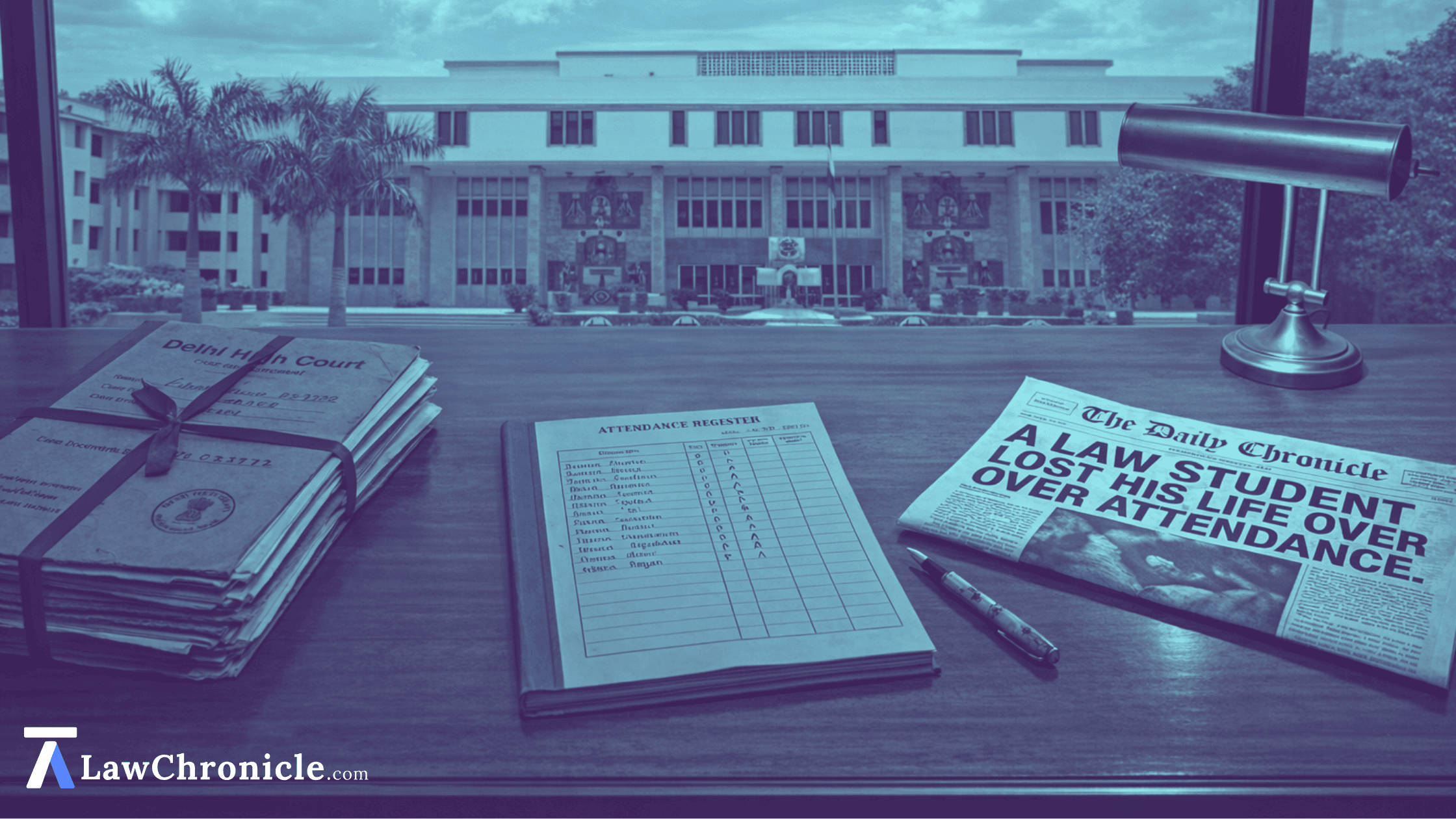
A 5-year BA LLB student committed suicide in 2016, allegedly due to mental torture and harassment by a teacher of the Law School. The major reason behind the feud which took a life pertains to the inability to maintain 75% attendance in Law College, prescribed by the University. The push to repeat an academic year, the continuous harassment from the faculty and the particular teacher, as also the administration forced the bright law student to commit suicide.
Faced with the question of Mandatory Law College Attendance, the Delhi High Court Judgment gave a glimpse of what’s wrong with the system, and the seemingly sound BCI attendance rules for law students.
Background of the Case
A letter stating this incident sought suo motu cognizance of the Supreme Court for the larger issue - the mental health problems of students in Institutes of Higher Education across the country. The PIL Committee directed the matter to be registered as a Writ Petition. After receiving Law School’s response, the matter was transferred to the Delhi High Court, while the criminal proceedings before the Magistrate proceeded. The case was titled as “In Re: Suicide Committed by Sushant Rohilla, Law Student of IP University”, heard by the Bench of Justice Prathiba M. Singh and Justice Amit Sharma. Several orders were passed in between,
The Writ Petition was being heard since 2017. Several directions have been passed from time to time, targeting reforms in Institutes of Higher Education, including order dated 9th September, 2024 in 2024 CaseBase(DEL) 2534, which included directions to seek instructions for compensation for the family of deceased law student. The ultimate goal was an environment conducive to learning and effective handling of issues plaguing students. The matter spread from one University in Delhi, to several universities and institutes, even beyond Law Schools, and those institutes were required to setup Grievance Redressal Committees for assuring physical and mental health of students.
When the question of 75% attendance in Law College came to Bar Council of India, the reasoning pertained to why it was necessary.
The Amicus Curiae sought measures for adequate academic support and mental/emotional well-being of students. A crucial suggestion for allowing virtual classes for those suffering from medical illnesses was put forward. Most importantly, 75% attendance for Law Students was sought to be avoided while striking a balance with standards for legal education.
Grievance Redressal Committees
Since the writ petition before the Delhi High Court travelled through a few years, several incidents of student suicides were noted. The High Court also referred to the Supreme Court decisions pertaining to the mental health of students in the cases of Amit Kumar (2025 CaseBase(SC) 255) and Sukdeb Saha (2025 CaseBase(SC) 523).
The Delhi High Court backed the effective functioning of GRC and observed that “presence of students in the Grievance Redressal Committees (GRCs) is critical, in view of the fact that effective inputs can be given by students while considering any complaint. Students are also well placed to interact with the specific individual, who may be facing a mental health issue. On a number of occasions, mere communication or conversation with the said student, who may be facing such issues, with her/his peers may alleviate the concerns or the difficulties.” The Court further directed for empanelment of trained therapists and counsellors on the GRC. The Court concluded the question of GRC with constitutional reasoning that “mental health is a part of the right to life guaranteed under Article 21 of the Constitution of India.”
75% Attendance in Law College
Before weighing upon the justification behind the 75% attendance rule for law students, the Delhi High Court scanned through the wider picture across educational institutes.
The National Education Policy, 2020
The High Court acknowledged that the NEP “substantially altered the manner in which education is perceived in India - from mere academic excellence to academic excellence plus skill-building.” The emphasis on compassion, empathy, courage and resilience to create a stimulating environment is the basis for NEP 2020. As highlighted by the Court, the regulation framework being ‘Light but Tight’.
Coming to the NEP scan for legal education, which it does not govern directly, the need for global competitiveness, adoption of best practices and embracement of advancing technologies for timely delivery of justice has been focused upon. The Court noted that NEP 2020 does not mention anything about mandatory attendance. As observed by the Delhi High Court, “It is striking that the NEP, 2020 which deals with and contemplates various issues that are key to development of a holistic and multidisciplinary learning environment, does not require students to attend the entire course in-person to achieve the said objective.”
Is 75% Attendance Mandatory for Law Students?
Legal Education is designed to not only teach students but also to train them for the practice of law. Therefore, the High Court considered the question of whether mandatory attendance in Law Colleges is non-negotiable? The Court noted the UGC Regulations which prescribe minimum 75% attendance, which is not confined to lectures but includes tutorials, seminars, practicals and any other prescribed curriculum requirements.
Comparison with other Courses
The Court sought to compare the mandatory attendance requirements for students of medicine, dentistry, and psychology, engineering, pharmacy, etc. The Court also noted the innovative attendance policy adopted by Birla Institute of Technology and Science (BITS), Pilani, where there is no minimum attendance for allowing appearance in examination.
Legal Studies
Dimensions in Study of Law
The High Court listed the three crucial facets in the study of laws for holistic legal education, to avoid half-baked knowledge and lack of adequate confidence:
- Knowledge of the law – Involves knowledge of statutes, rules, regulations, jurisprudence and inception of law.
- Practical application of the law – Involves application of the theoretical aspects in different real-life, factual and practical situations.
- Implementation of the law – Involves understanding of implementation of law by visiting courts, legal aid clinics, prisons and other legal institutions.
BCI Attendance Rules for Law Students
The High Court scanned the history of legal education, establishment of the Bar Council of India under the Advocates Act, 1961, as the Apex Regulatory Body. One of its functions of laying down standards of legal education in consultation with the State Bar Councils and Universities in India. The BCI Rules have been amended several times, initially recognizing only 3-year law degree, then prescribed a 5-year law degree, 1998 Rules prescribing compulsory classes for 30-hours a week, with minimum 66% classroom attendance.
The Court further considered the judgments in Baldev Raj Sharma (1989 CaseBase(SC) 152), Aparna Basu Mallick (1994 CaseBase(SC) 379) and Naincy Sagar (2019 CaseBase(DEL) 9107), passed before the NEP 2020 came into force. The Delhi High Court acknowledged the NEP’s greater emphasis on “holistic learning and overall well-being of students”. The Court sought reconsideration of detention of students from appearance in a particular semester or examination by the BCI. Not diluting the BCI’s regulatory powers, the Court sought reconsideration of the mandatory norms, the BCI attendance rules for Law Students. The High Court even questioned BCI’s invasive steps for ensuring mandatory implementation vide biometric attendance and CCTV cameras. It further pointed at the Legal Education Rules, 2008, reflecting upon the minimum number of class hours and working days.
The Court referred to Adarsh Raj Singh (2018 CaseBase(DEL) 799), where the Court dealt with a similar issue on shortage of attendance in Law Schools. The Bench therein noted that “law colleges, Universities and institutions often fail to hold the statutorily prescribed mandatory minimum number of class hours and working days, leading to inadequacy in the opportunity for the students to make up the shortfall in their attendance before the conclusion of an academic semester.” The High Court accordingly reminded BCI of its responsibility to ensure compliance with BCI Rules, 2008 so that students get sufficient opportunity to make up for loss of attendance. The Court stated that “By holding lesser number of classes than those are prescribed, students in effect are compelled to attend 100% of all classes taken by teachers – in effect taking away the flexibility of 30% which is available to them.”
The High Court also found the Rule 12 of Legal Education Rules, 2008 “extremely strict”, leaving little room for relaxation, since it bars students with less than 70% attendance from taking end semester exams. It opined that an inflexible approach in BCI attendance rules for law students is bound to have a cascading effect, resulting in extreme consequences upon their mental health and career prospects. The High Court discussed the necessary acknowledgement of moot courts, seminars, debates, practical training in Courts, internships, visits to legal aid clinics, prisons, juvenile homes, Trial Courts, Registrar Courts, High Courts and even the Supreme Court etc. for the enormous learning opportunity. The High Court emphasized that “The reading of the Constitution of India, or of the Civil Procedure Code from a bare act, though is extremely crucial, is still very different from seeing how an interim order is passed in the Court or the Fundamental Rights enshrined in the Constitution of India are given effect to in a particular case. Hence, if law students have to turn out to be holistic lawyers, flexibility in attendance is absolutely essential.”
Life Happens Outside Classrooms
The Delhi High Court while expressing concern over extreme rules of detention in lack of 75% attendance for law students touched upon the facets of everyday life. The Court stated that “The possibility that students may themselves have medical complications or medical exigency in families or may be undergoing mental stress due to several external factors, are all different paradigms of human experiences which cannot be ignored while designing the attendance structures in our educational institutes.” The Bench sought reconsideration of the inflexible Rule 12 of the Legal Education Rules, 2008 by the BCI.
Mechanisms for Shortage of Attendance in Law Schools
The Delhi High Court laid down three methods for dealing with attendance shortage for Law Students:
- In case of shortage in attendance, there is detention of the student and the student is barred from appearing in the examination. This is clearly an extreme measure;
- In case of shortage in attendance, various ameliorative steps are taken by certain institutions right from the inception in the following manner:
-
Uploading of weekly attendance on a common portal which is regularly accessible to the students;
-
Notification of attendance on a monthly basis to the student and the parents;
-
Extra classes being provided for students who missed classes;
-
Extra assessments to be completed by students to cover up the curriculum missed in unattended lectures.
-
If the student still does not satisfy the attendance norms despite all the measures, then the student is barred from taking the examination.
-
Even if the student is barred, instead of detention of student from proceeding to the next semester, supplementary examinations are held prior to the commencement of the next semester, provided some measures are taken by the student.
3. Several institutions are taking measures to reduce either the CGPA or the marks awarded, if the student is short of attendance.
The Court found second and third methods feasible to maintain a competitive edge among students, while avoiding a state of depression and degrading mental health. The Court expressed that “Legal education does not merely require rote-learning or one-sided teaching. It has various dimensions to it, such as knowledge of law, practical application of the law as also implementation thereof. In order to obtain such holistic education, mere presence in classrooms is neither required, nor can be sufficient. The classroom education has to be coupled with practical training, knowledge of court systems, prison systems, legal aid, gaining practical experience through participation in moot courts, seminars, model parliament, debates, attending court hearings etc.”
The High Court respected the purpose of classroom learning but sought the flexibility as against rigidity as followed under the NEP 2020 and the UGC Regulations 2003. The question on law student attendance by Delhi High Court judgment cannot be concluded without the ever-prevalent practice of proxy attendance. The Court also touched upon the difficulties faced by students short of attendance, including financial distress, responsibilities of families, commute from far off places, difficulties of independent living, etc. The authorities often turn a blind eye to such difficulties, in order to follow the mandatory physical attendance norms in law school.
Delhi High Court Directions Against Mandatory Attendance Rule
The Delhi High Court observed that “Right to appear in an examination can be curbed only on grounds and conditions which are reasonable and not arbitrary.” Therefore, the Court issued the following directions:
For Grievance Redressal Committees
The Delhi High Court has directed that all universities and colleges must set up proper student grievance committees as required by UGC rules. Most importantly, students must make up at least 50% of the committee's members and be treated as full members, not just observers. These committees must also include mental health professionals like counsellors and therapists. Law schools specifically must appoint psychologists in their GRCs, as directed to the Bar Council of India.
On 75% Attendance for Law Students
The Court has directed the Bar Council of India to rethink its strict attendance rules for law students, bringing them in line with the more flexible approach suggested by the National Education Policy 2020. In the meantime, no law student can be barred from appearing in exams or held back solely for low attendance. Instead, colleges must offer alternatives like extra classes, home assignments, and legal aid clinic work to make up the shortfall. If a student still falls short, only a small grade reduction is permitted. The Court also struck down a recent BCI circular mandating biometric attendance and CCTV cameras in law colleges.
 Breaking News