


SC: Article 21 Cannot Dilute Sec. 37 NDPS Rigours, Bail Set Aside
 Copy Link
 Share
Share Save
Save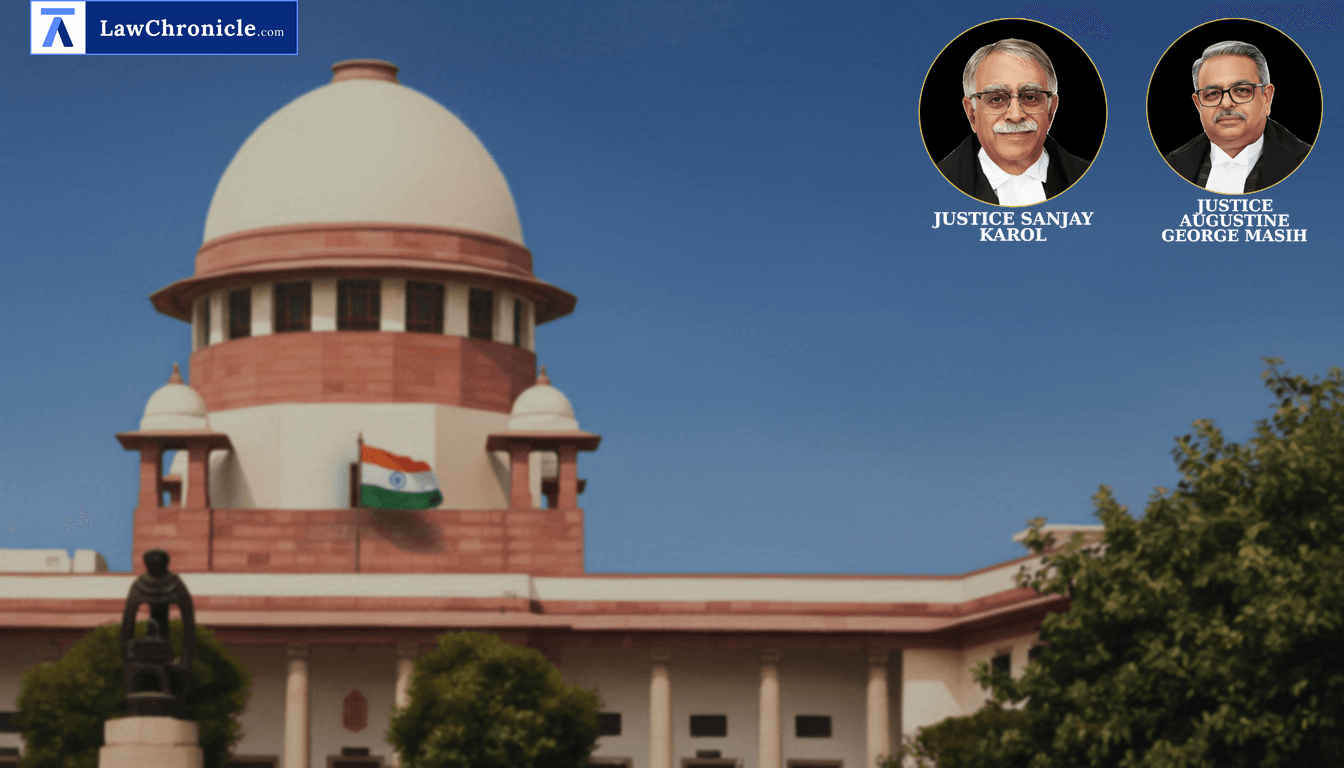
The Supreme Court, in State of Punjab v. Sukhwinder Singh @ Gora, held that while the right to a speedy trial enshrined under Article 21 of the Constitution of India is undoubtedly a valuable constitutional guarantee, it cannot operate in isolation when a special legislation like the Narcotic Drugs And Psychotropic Substances Act, 1985 (NDPS Act) is in play. Specifically, in cases involving commercial quantity of narcotic substances, the said right must be interpreted in harmony with, and not as a substitute for, the stringent twin conditions prescribed under Section 37 of the NDPS Act.
A bench of Justice Sanjay Karol and Justice Augustine George Masih heard appeals challenging High Court orders that had granted regular bail to two accused in a case arising out of the seizure of contraband during a naka operation and the appeals concerned the proper application of Section 37(1)(b)(ii) of the Narcotic Drugs And Psychotropic Substances Act, 1985 and bail jurisdiction under Section 483 of the Bharatiya Nagarik Suraksha Sanhita, 2023. The appeals arose from separate High Court orders dated 18.02.2026 which enlarged the respondents on bail in connection with FIR No. 06 of 2024 registered at Police Station Khalra, District Tarn Taran, where an aggregate of 1.465 kilograms of heroin was recovered, an admitted commercial quantity under the Narcotic Drugs And Psychotropic Substances Act, 1985.
The Court allowed the appeals and set aside the impugned High Court orders, holding that in cases involving commercial quantity the statutory twin satisfaction under Section 37(1)(b)(ii) of the Narcotic Drugs And Psychotropic Substances Act, 1985 was mandatory and had not been recorded. The Court emphasised that the right to speedy trial under Article 21 could not be used to override the mandatory pre-conditions of the special enactment and observed that the High Court had proceeded on a proposition that "the rigors of Section 37 of the Narcotic Drugs And Psychotropic Substances Act, 1985 can be diluted bearing in mind the right to a speedy trial," an approach the Supreme Court found impermissible in the absence of the required recorded satisfaction.
The Court, in its reasoning, observed: "It is well-settled that in matters involving recovery of contraband in commercial quantity, the twin conditions under Section 37(1)(b)(ii) of the Narcotic Drugs And Psychotropic Substances Act, 1985 are mandatory and entail no relaxation merely on the ground that the accused has undergone prolonged incarceration during the pendency of trial. The provision casts upon the Court a duty to record, before enlarging an accused on bail, its satisfaction on two cumulative conditions, first, that there exist reasonable grounds for believing that the accused is not guilty of the offence charged; and second, that he is not likely to commit any offence while on bail. The recording of such satisfaction is not a mere formality, the non-observance of which vitiates the grant of bail."
Background
The factual matrix in both matters was common: on 10.01.2024 a Mahindra XUV-300 was stopped at a police barricade near Village Veeram, District Tarn Taran, and two occupants were apprehended. Searches yielded three packets of heroin aggregating 1.465 kilograms 957 grams from one accused and 508 grams from the other and the trial court framed charges on 20.07.2024 under Sections 21(c) and 29 of the Narcotic Drugs And Psychotropic Substances Act, 1985. Each respondent had earlier filed and withdrawn or faced dismissal of a prior bail petition before approaching the High Court, and the High Court recorded considerations including prolonged custody, limited progress of trial (two out of 24 prosecution witnesses examined), parity with a co-accused on bail, and the respondent's asserted lack of other involvement or antecedents, and consequently enlarged the respondents on regular bail under Section 483 of the Bharatiya Nagarik Suraksha Sanhita, 2023.
The State challenged those orders before the Supreme Court, urging that because the recovery was admittedly of commercial quantity the rigours of Section 37(1)(b)(ii) of the Narcotic Drugs And Psychotropic Substances Act, 1985 applied and the High Court was bound to record its satisfaction on the twin cumulative conditions before granting bail. The State relied on Narcotics Control Bureau v. Kashif ( "(2024) 11 SCC 372": 2024 CaseBase(SC) 891), State of Meghalaya v. Lalrintluanga Sailo and Another and Union of India v. Ajay Kumar Singh to stress that the recording of the twin conditions was mandatory and that orders granting bail without such recorded satisfaction were liable to be set aside. The State also referred to Parwinder Singh v. State of Punjab to note the need for circumspection in bail grants in view of the drug menace in Punjab.
The respondents defended the High Court orders, emphasising prolonged incarceration since 10.01.2024, the slow pace of trial with only two witnesses examined, alleged violations of statutory safeguards at arrest and search, absence of independent witnesses, and parity with the co-accused who had been released on bail; they urged that Article 21's guarantee of speedy trial justified relief. The Supreme Court, however, found multiple infirmities in the High Court reasoning: absence of any explicit recorded satisfaction on the twin conditions of Section 37(1)(b)(ii) of the Narcotic Drugs And Psychotropic Substances Act, 1985, factual contradictions in the High Court order (for example, the High Court recorded that the respondent was "not involved in any other case" though the respondent's own petition disclosed another FIR), and inadequate disclosure regarding earlier bail petitions. The Court held that these defects warranted setting aside the impugned orders and remitted the matter to allow the respondents to surrender and apply afresh for bail before the competent trial court.
The Supreme Court therefore allowed the appeal, set aside the High Court orders dated 18.02.2026, directed the respondents to surrender before the trial court within one week from the date of the order, and granted liberty to apply afresh for regular bail on surrender; pending applications were disposed of.
Case Details:
Case No.: CRIMINAL APPEAL NO. OF 2026 (ARISING OUT OF SLP (CRL.) NO.5020 OF 2026)
NeutralCitation: 2026 INSC 411
Case Title: State of Punjab v. Sukhwinder Singh @ Gora
Source: 2026 CaseBase(SC) 363
 Breaking News