

SC: Haryana Regularisation Policies Partly Upheld, Quashed Arbitrary Scheme
 Copy Link
 Share
Share Save
Save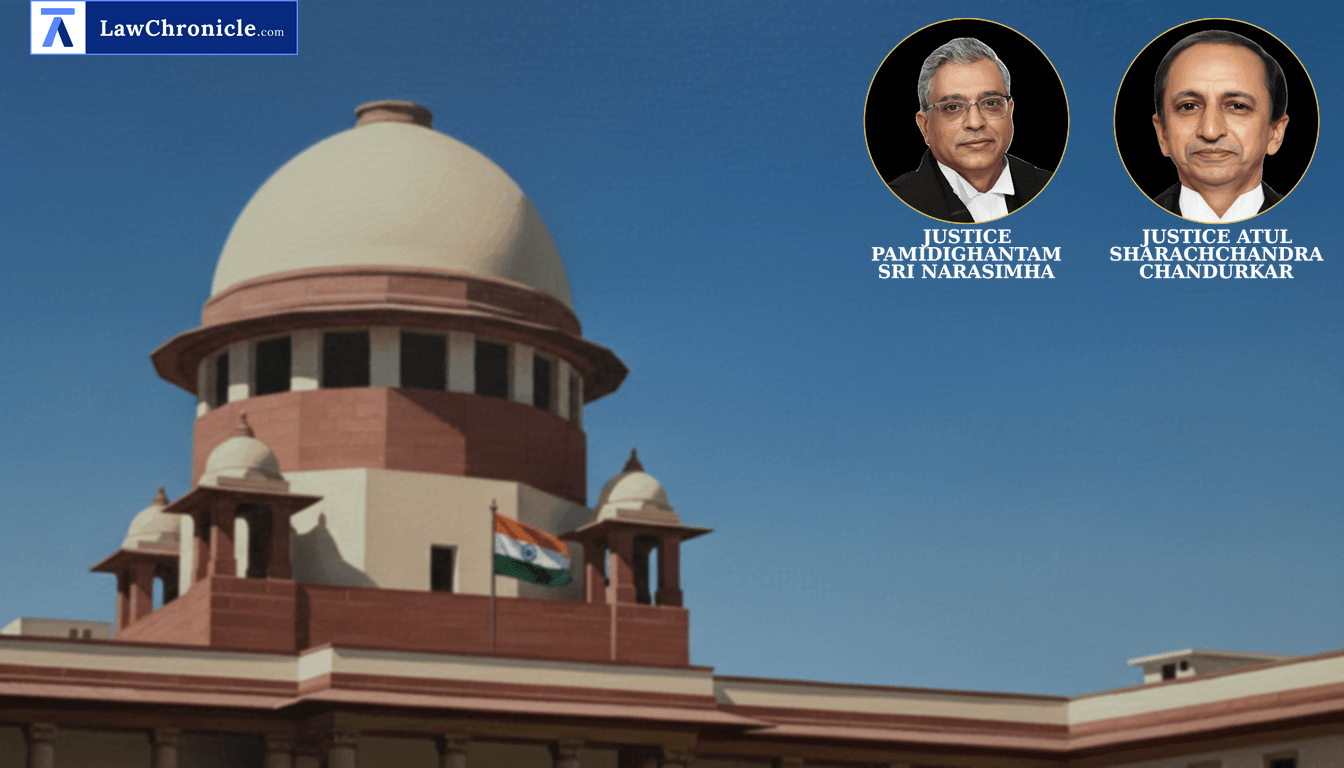
A bench of Justice Pamidighantam Sri Narasimha and Justice Atul S. Chandurkar heard appeals challenging the Punjab and Haryana High Court's common judgment that had quashed Government of Haryana Notifications seeking to regularise contractual, ad hoc and daily wage employees in Groups B, C and D. The appeals arose from a batch of writ petitions and focused on the validity of Notifications dated 16.06.2014, 18.06.2014 and 07.07.2014 that purported to regularise services of certain categories of employees.
The Court summarised its decision by holding that the Notifications dated 16.06.2014 and 18.06.2014 were valid and that the High Court was not justified in quashing them, while the Notifications dated 07.07.2014 were arbitrary and illegal but relief to incumbents would be moderated in view of long continuance in service. The Court observed the legal framework established by precedent and invoked equitable powers to avoid immediate dislocation.
The Court, in its reasoning, observed: "5. It is evident from the above that there is an exception to the general principles against 'regularization' enunciated in Umadevi, if the following conditions are fulfilled: (i) The employee concerned should have worked for 10 years or more in duly sanctioned post without the benefit or protection of the interim order of any court or tribunal. In other words, the State Government or its instrumentality should have employed the employee and continued him in service voluntarily and continuously for more than ten years. (ii) The appointment of such employee should not be illegal, even if irregular. Where the appointments are not made or continued against sanctioned posts or where the persons appointed do not possess the prescribed minimum qualifications, the appointments will be considered to be illegal. But where the person employed possessed the prescribed qualifications and was working against sanctioned posts, but had been selected without undergoing the process of open competitive selection, such appointments are considered to be irregular. (iii) Umadevi casts a duty upon the concerned Government or instrumentality, to take steps to regularize the services of those irregularly appointed employees who had served for more than ten years without the benefit or protection of any interim orders of courts or tribunals, as a one time measure. Umadevi, directed that such one time measure must be set in motion within six months from the date of its decision (rendered on 10.4.2006)."
Background
The dispute arose after the General Administration Department of the State of Haryana issued a sequence of Notifications beginning with a 29.07.2011 exercise and then further Notifications dated 16.06.2014, 18.06.2014 and 07.07.2014 to regularise certain contractual/ad hoc/daily-wage employees in Groups B, C and D. The High Court found that those later Notifications contravened the law as expounded by this Court and quashed the 2014 Notifications, directing withdrawal of benefits and ordering fresh recruitment processes while temporarily allowing incumbents to continue for six months. The State and beneficiaries appealed.
The appellants contended that the Notifications were bona fide executive acts taken under Article 162 of the Constitution of India, 1950 to meet administrative exigencies; that the criteria in the policies preserved requirements of qualification and sanctioned posts; and that denial of regularisation would cause hardship. The respondents countered that regularisation could not be used as a mode of recruitment and that when recruitment rules framed under Article 309 of the Constitution of India, 1950 existed, executive regularisation was impermissible and violated Articles 14 and 16 of the Constitution of India, 1950. An amicus emphasized that appointments made in breach of the constitutional scheme and statutory rules could not be regularised and suggested case by case verification and possible use of Article 142 of the Constitution of India, 1950 for complete justice.
In settling the conflict, the Court relied on the principles in Secretary, State of Karnataka and others Vs. Umadevi and others ( "2006 INSC 216": 2006 CaseBase(SC) 148) to frame the permissible scope of a "one time measure" for regularisation and on State of Karnataka and others Vs. M L Kesari and others ( "2010 INSC 469": 2010 CaseBase(SC) 230) to explain that a department's failure to complete the one time exercise within six months did not necessarily defeat the entitlement of eligible employees who had put in long service. The Court further applied the remedy in State of Punjab and others Vs. Jagjit Singh and others ( "2016 INSC 993": 2016 CaseBase(SC) 490) to direct that incumbents protected as an exception would be placed at the lowest admissible pay scale. The Court therefore upheld the Notifications of 16.06.2014 and 18.06.2014 as restoring benefits to those who satisfied the stated criteria, while striking down the 07.07.2014 Notifications because they sought to regularise employees engaged without advertisement or interview and by reference to a future cut off date. The Court, exercising jurisdiction under Article 142 of the Constitution of India, 1950, allowed incumbents covered by the invalid 07.07.2014 Notifications to continue in service but ordered that "They shall, however, be placed at the lowest pay scale" of the post and that verification by competent authority would be required.
The result was therefore a partial modification of the High Court's order: validation and protection for beneficiaries under 16.06.2014 and 18.06.2014 subject to verification, invalidation of the 07.07.2014 Notifications with limited protection to continuing incumbents, and liberty to other affected parties to take appropriate steps in accordance with the judgment. The Court disposed of all appeals with no order as to costs.
Case Details:
Case No.: CIVIL APPEAL NO.1996 OF 2024
NeutralCitation: 2026 INSC 379
Case Title: MADAN SINGH AND OTHERS v. STATE OF HARYANA AND OTHERS
Source: 2026 CaseBase(SC) 333
 Breaking News