

SC Restores NCLT Order Allowing CIRP, Holds Delayed Scheme of Arrangement Inoperative
 Copy Link
 Share
Share Save
Save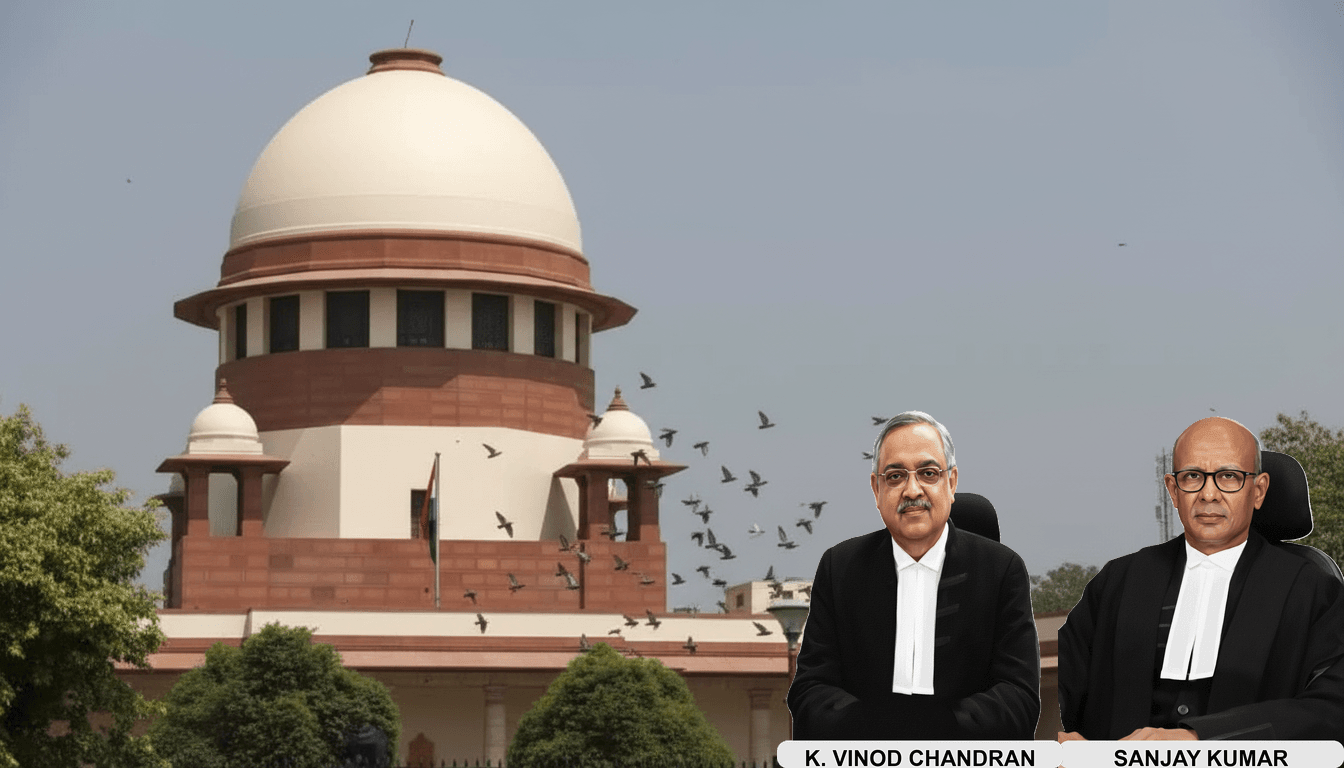
A bench of Justices Sanjay Kumar and K. Vinod Chandran heard an appeal by Omkara Assets Reconstruction Private Limited challenging an Appellate Tribunal order that had kept in abeyance the Section 7 insolvency petition filed by the bank’s Stressed Assets Stabilization Fund to initiate Corporate Insolvency Resolution Proceedings (CIRP) against a corporate debtor. The question before the Court was whether pending proceedings relating to a Scheme of Arrangement (SOA) under Sections 391–394 of the Companies Act would bar initiation of CIRP under the Insolvency and Bankruptcy Code, 2016 (IBC), particularly where statutory timelines for the SOA had not been complied with and creditor dues had substantially increased.
The Court allowed the appeal, set aside the Appellate Tribunal order and restored the Adjudicating Authority’s order admitting the Section 7 petition. The bench held that the SOA, as pleaded, had become “defunct and unenforceable” by reason of gross delay and failure to comply with statutory timelines, and that the IBC proceeding could not be stalled on the ground of mere pendency of long‑delayed Company Court proceedings. The Court observed that “the SOA of 2008 never came into operation and the sanction in the year 2019 was without jurisdiction and after it had become redundant and inoperable for sheer passage of time.” The Court, in its reasoning, observed: “25. A conspectus of the aforesaid authorities would show that a petition either under Section 7 or Section 9 IBC is an independent proceeding which is unaffected by winding‑up proceedings that may be filed qua the same company. Given the object sought to be achieved by the IBC, it is clear that only where a company in winding up is near corporate death that no transfer of the winding‑up proceeding would then take place to NCLT to be tried as a proceeding under the IBC. Short of an irresistible conclusion that corporate death is inevitable, every effort should be made to resuscitate the corporate debtor in the larger public interest…” The bench directed that the Interim Resolution Professional (IRP) was entitled to proceed and vacated the interim direction that had kept the management in the loop of day‑to‑day affairs.
Background
The dispute arose from two term loans disbursed in 1999 and 2000 to the corporate debtor, where default was said to have commenced in 2003. The Stressed Assets Stabilization Fund (predecessor to the appellant) moved the Company Law Tribunal under Section 7 IBC for recovery of Rs.154,33,12,274/- (with future interest) on the asserted outstanding liability. The corporate debtor resisted on the ground that a Scheme of Arrangement under Sections 391–394 of the Companies Act had been approved by the Company Court and that these Company Court proceedings were pending before the Punjab & Haryana High Court, a fact which the debtor said made initiation of CIRP inappropriate.
The Adjudicating Authority held that the debtor had not established compliance with the statutory requirements for bringing the SOA into effect, noted intervening enforcement actions under the SARFAESI Act and recovery proceedings before the DRT, and admitted the Section 7 petition. The Company Law Appellate Tribunal kept the Section 7 application in abeyance pending disposal of the High Court proceedings. This Court earlier issued interim directions reviving the moratorium and permitting the IRP to resume charge; in the present judgment the Court adjudicated the merits.
The Supreme Court examined the Companies (Court) Rules, 1959 and the Companies (Transfer of Pending Proceedings) Rules, 2016 and found multiple material lapses: the creditor meeting report dated 25.07.2008 was not followed by the required second motion within the prescribed period; the High Court’s later sanction order of 23.07.2019 was inordinate and failed to comply with the requirement of filing a certified copy with the Registrar within the prescribed time; the order was recalled by the Company Judge as inoperative; and Form INC‑28 was filed only on 06.07.2023. The Court found these failures made the SOA “redundant and inoperative” and that judicial discipline could not be invoked by “tardy litigators” to jeopardize public funds and stall a statutory insolvency remedy. The Court relied on precedents holding that Section 7 petitions are independent proceedings and emphasized the IBC’s objective of revival. The appeal was allowed; the Appellate Tribunal’s order was set aside; the Tribunal (Company Law Tribunal/NCLT) order admitting the Section 7 petition stood restored; the IRP was permitted to proceed and the earlier interim direction keeping the management in the loop was vacated. Pending applications were disposed of.
Case Details:
Case No.: Civil Appeal No.11417 of 2025 (2026 INSC 189)
Case Title: Omkara Assets Reconstruction Private Limited v. Amit Chaturvedi and Ors.
Appearances:
For the Petitioner(s): Mr. Neeraj Kishan Kaul, Senior Counsel
For the Respondent(s): Ms. Purti Gupta, Counsel; Mr. Ritin Rai, Senior Counsel (appearing for applicant in I.A. No.54690 of 2026)
 Breaking News